

You are 70 pages into the book club selection, the meeting is tomorrow, and opening the book now produces a peculiar mix of guilt and resistance. The tempting options are to speed-read without retaining anything, search for a summary, or arrive hoping nobody asks what you thought.
There is a better fourth option: attend as a partial reader and contribute within the boundaries of what you actually read. A book discussion is not a final exam. If you can describe where the book lost you, name what it seemed to be trying to do, and ask a question that gives finished readers room to respond, you can add something real to the conversation.
The key is not to turn an incomplete read into a verdict on a whole book. It is to turn your specific reading experience into a useful piece of the group’s discussion.
Choose to stop on purpose instead of quietly drifting away
There is an important difference between deciding that a book is not working for you and leaving it unfinished by accident. The first creates a clear stopping point and a few usable observations. The second often leaves you with only a vague feeling that the book was “slow.”
Before the meeting, give yourself ten quiet minutes to make a deliberate choice. Ask:
- Is my resistance about the book, or about my week? A demanding week may call for one focused reading session rather than a permanent decision.
- Have I reached enough of the book to identify what is not connecting? You do not need a universal rule about page counts. One person may know after a chapter that a narrative voice is unbearable; another may need several chapters to see the book’s pattern.
- Would another hour of reading change my experience, or only make me resent the meeting? If the latter is more likely, stop intentionally.
If you decide to stop, record your place by chapter, section title, or a brief description of the last scene. Page numbers can differ among editions, and “I stopped shortly after the dinner scene in chapter 5” is more useful to a group than “page 82.”
An unfinished book is not empty-handed reading. It becomes useful when you can separate “this did not work for me here” from “this book has nothing to offer anyone.”
Make a small evidence packet before you go
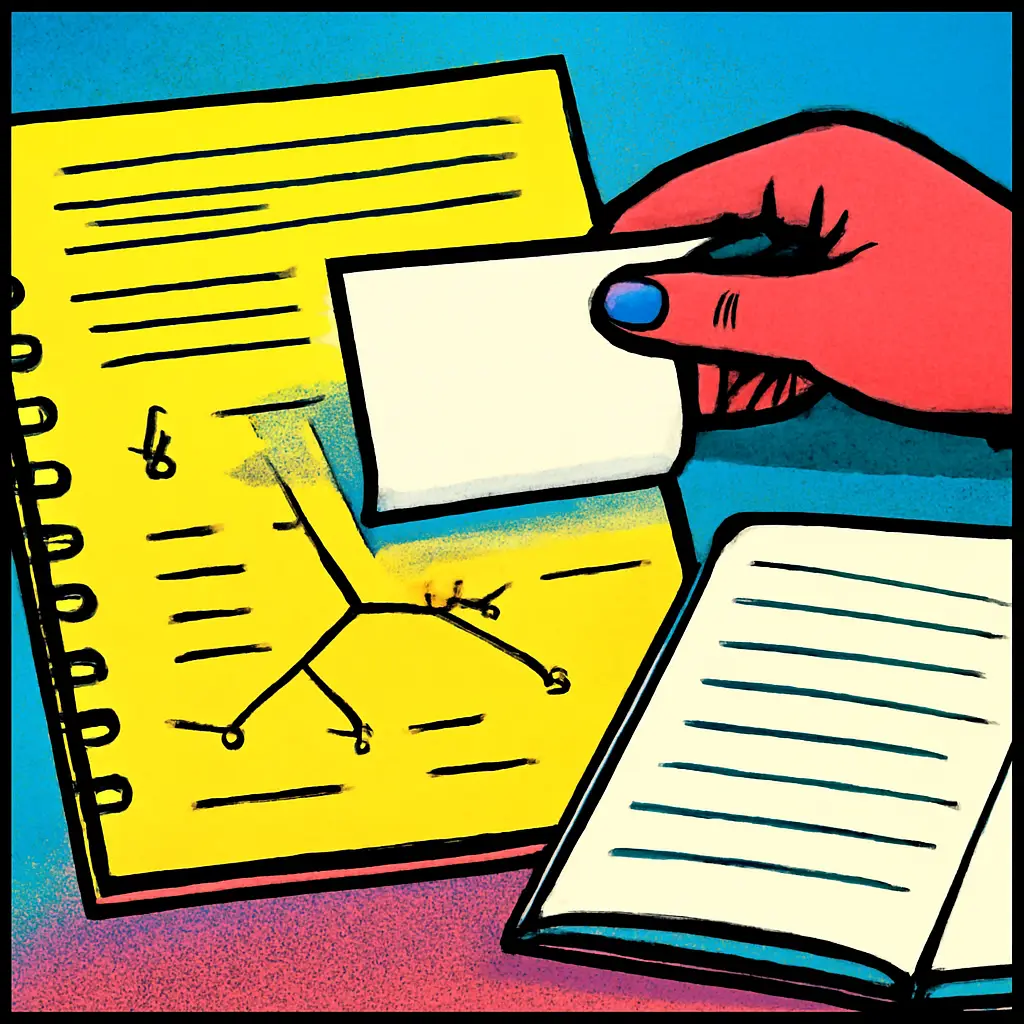
Your goal is not to construct a defense for quitting. It is to preserve enough detail that you do not have to speak in foggy generalities. A short note in your phone or on a scrap of paper is enough.
Write down four things
- Your stopping point. Note the chapter or scene, and say plainly that you did not finish.
- One concrete detail. This might be an image, a repeated phrase, a choice a character made, an argument the author introduced, or the shape of the opening. Pick something you can describe accurately without looking up what happens next.
- The mismatch. Name the friction precisely. Perhaps the narration kept you at a distance, the humor undercut the stakes, the time shifts made it hard to settle, or the central question did not feel urgent to you.
- One open question. Ask what a reader who continued might have noticed or reconsidered.
Specificity makes your comment fairer. “The writing was bad” closes a conversation and makes a claim you cannot support. “The long descriptive passages made the narrator’s urgency hard for me to feel; did that distance become meaningful later?” gives other members something to answer.
Do not feel obliged to copy a quotation. A quotation can be helpful when you have marked it carefully, but a rushed or half-remembered quote can distort the text. A scene or pattern in your own words is usually enough.
Identify the book’s opening contract
Most books make an early, informal promise to the reader. A mystery may promise that an unsettling event will be examined. A memoir may promise an intimate voice. A novel with multiple narrators may promise that the separate viewpoints will eventually illuminate one another. A nonfiction book may promise a problem it intends to explain.
Try completing this sentence: “At the beginning, I thought this book was inviting me to ______.” Then add: “I stopped because I was not yet getting ______.”
This is more illuminating than simply calling a book disappointing. It also leaves room for the possibility that the book later fulfills its promise in a way you did not reach.
Do not use summaries to impersonate a finished reader
It may seem considerate to read a plot summary before the meeting. Usually, it makes the discussion harder. You may accidentally repeat an interpretation you did not develop, react to an ending you did not experience, or lose track of which parts are your own response and which parts you learned secondhand.
There is one modest exception: if your group has explicitly agreed to discuss spoilers freely and you want to decide whether to finish the book later, a brief description may be useful after the meeting. It is not a substitute for reading, and it should not become material you present as though you encountered it in the book.
Skip reviews for the same reason before the gathering. Reviews can be enjoyable and perceptive, but they can supply a ready-made judgment that flattens your own partial, still-interesting response. Bring your question first. You can seek other interpretations later.
Use language that is honest without making yourself the center of the meeting
A simple disclosure at the start prevents awkwardness later: “I got through chapter 5, so I’m speaking only about the opening.” Say it once, matter-of-factly. You do not need to apologize at length, catalogue your schedule, or persuade everyone that you had a good reason.
Then offer your observation and question. These sentence shapes keep the limits clear:
- “Up to the point where I stopped, I noticed ______. Did that pattern change?”
- “I had trouble connecting with ______, especially when ______ happened. What helped it click for those who continued?”
- “The opening seemed to frame this as a book about ______. Did that remain the central concern?”
- “I may be reacting to the early pacing rather than the whole novel. When did the structure start paying off for you?”
These are not evasive phrases. They accurately locate your evidence. They also invite a better conversation than “Does it get better?” That question often asks the group to deliver a yes-or-no reassurance. Asking what changed, what mattered, or how another reader understood the opening gives them something substantive to discuss.
Let finished readers have the last word on later events
You can disagree with the book’s early choices. You cannot fairly announce that its character arc fails, its argument collapses, or its ending is unearned if you have not read those parts. Keep your claims attached to the portion you know.
If someone says, “That becomes important later,” resist the urge to demand proof or to treat that answer as a rebuke. You can ask one follow-up question, such as “Did it make the early repetition feel different in retrospect?” Then make space for the group to move on. A book club is a shared discussion, not a trial over whether you were justified in stopping.
Turn your stopping point into a group-friendly question
The most useful contribution from a partial reader is often a question that reveals a divide in the room. Look for a point where you made an assumption about the book. Finished readers can tell you whether the assumption held, reversed, or missed the point.
For example, imagine a hypothetical reader who stops during chapter 4 of a novel told by an observant but emotionally reserved narrator. Their note might read: “I could see the narrator noticing every social detail, but I could not tell what the narrator wanted. Did the restraint eventually create tension for you, or did it remain emotionally distant?”
That question does three things. It names a feature of the writing, explains the reader’s response, and avoids spoiling or prejudging the rest of the story. Even members who disliked the book can answer it differently, which is often where the best discussion begins.
Good questions are usually about choices rather than ratings:
- What did the book gain or lose by withholding this information?
- Did the early voice make you trust the narrator, or keep you skeptical?
- Was the slow beginning laying groundwork, or asking for too much patience?
- Which detail from the opening seemed minor at first but mattered later?
Know when to skip the meeting instead
Partial participation is not always the right fit. Consider sitting this one out if the club has clearly set a completion expectation, if the meeting is a rare author visit and you cannot engage respectfully with the work, or if the book’s subject matter is personally upsetting enough that discussion would be draining rather than worthwhile.
A short message to the organizer is enough: “I wasn’t able to finish this month’s book, so I’ll sit this discussion out and join the next one.” There is no need to disclose private details. If the group welcomes unfinished readers, attend; if it does not, protect both your time and the group’s norms.
Also notice a recurring pattern. If nearly every selection leaves you stranded, the issue may not be your discipline. The club’s genre range, pacing preferences, or meeting format may not match what you want from recreational reading. That is useful information, not a character flaw.
Bring a four-line card, not an excuse
Before you leave for the meeting, write these four lines:
- I stopped at: ______.
- I noticed: ______.
- I struggled with: ______.
- I want to ask: ______.
That card is enough. It gives you a way into the conversation while keeping you truthful about the ground you covered. Next time a book club pick stalls, make the card at the moment you decide to stop rather than waiting until the night before. Your future self will have a clearer, kinder starting point.







Ad