

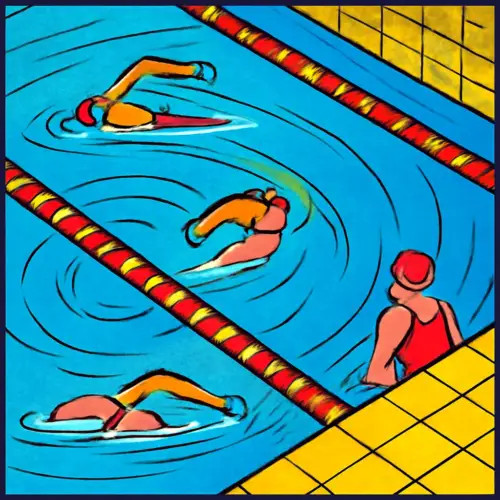
You arrive at the pool with a neat 1,500-yard plan in mind, then find one open lane holding three people who all swim at different speeds. The temptation is to skip the workout or force the plan through, passing too close, stopping at the wall frustrated, and apologizing every length.
A better approach is to build a session from short, swappable pieces. You still get a purposeful practice, but the structure bends around the lane rather than treating other swimmers as obstacles. This is especially useful for recreational lap swimmers who do not control the lane, are returning to regular swimming, or have only a limited pool window.
The goal is not to squeeze the maximum possible distance from a crowded lane. It is to leave having practiced a skill, accumulated comfortable aerobic work, and shared the space calmly.
A crowded lane is not a failed workout. It is a different training condition: one that rewards awareness, repeatable effort, and a plan with room to breathe.
Start by reading the lane before you get in
Take a minute on deck. Notice whether swimmers are splitting the lane or circle swimming, how often they stop, and roughly how long they take to cover a length. Pool signs and lifeguard direction take priority; lane customs vary.
A split lane usually means each swimmer stays on one side, which works best for two swimmers of similar enough speed. Circle swimming means everyone keeps to the right, swims down one side and returns on the other. It is often the practical choice for three or more swimmers. Do not quietly begin circle swimming in a split lane, or vice versa. Make eye contact and ask before entering if the arrangement is not obvious.
Then choose the lane that matches your sustainable pace, not the lane that looks emptiest from afar. A lane with two swimmers moving steadily may be easier to share than a lane with one person doing frequent short sprints and long rests.
Use one plain question
“Mind if I join? Are you splitting or circling?” solves most uncertainty. If you expect to stop frequently for a drill, add that information: “I’ll be doing some short drill repeats and will stay out of the way at the wall.” That lets others anticipate your rhythm.
Enter from the corner after the nearest swimmer has passed. Avoid diving or pushing off directly into someone’s path. These small choices make the rest of the session smoother.
Choose a workout goal that survives interruptions
Some plans depend on exact send-off times, open water at every turn, or all-out efforts. Those can be excellent in a dedicated lane, but they are fragile in a mixed public lane. For a shared lane, select one primary goal from the following:
- Technique: maintain a relaxed body line, steady exhale into the water, or a quieter hand entry.
- Easy endurance: collect several comfortable chunks of swimming, with rests as needed.
- Controlled pace changes: alternate relaxed and moderately purposeful lengths without sprinting blindly.
- Stroke variety: use backstroke, breaststroke, or approved drill lengths to change the load and maintain attention.
“Controlled” matters. If you cannot pass safely, an intended fast length can become an easy one. That is not wasted work; it is a deliberate adjustment to the environment.
For many swimmers, technique and easy endurance are the most crowd-proof choices. They benefit from frequent resets at the wall and do not require you to chase a clock.
Replace one long set with repeatable modules
A module is a small block with one job. It may be four lengths, two minutes of easy swimming, or a short drill-and-swim pairing. Its power is that you can repeat it, shorten it, or change it without losing the logic of the workout.
Use lengths rather than a fixed distance if you do not know the pool length. One length is from one wall to the other; two lengths is down and back. This keeps the plan usable in pools of different sizes.
| Module | What to do | Why it fits a busy lane | How to adjust |
|---|---|---|---|
| Settle in | 4 to 8 easy lengths, resting briefly whenever needed | Lets you learn the lane rhythm before asking more of yourself | Stop after 4 lengths if the lane is congested; add lengths if it opens up |
| Skill pairing | 1 drill length, then 1 easy swim length; repeat 2 to 4 times | Short repeats create natural opportunities to yield at the wall | Choose a simple drill you already know, or replace the drill with very easy swimming |
| Steady block | 4 lengths at a conversational effort, then rest | Builds endurance without demanding an exact pace clock | Use 2 lengths when traffic is heavy; use 6 to 8 when the lane is clear |
| Gentle change-up | 1 relaxed length, 1 purposefully steady length; repeat 2 to 4 times | Offers variety while leaving room to abandon the faster length safely | Make every length relaxed if you are catching people often |
A complete session can be as simple as: settle in, skill pairing, steady block, gentle change-up, then an easy finish. Repeat only the modules that are working well that day. There is no need to force every category into every swim.
Make passing predictable rather than competitive
In a circle-swim lane, faster swimmers commonly touch the feet of the swimmer ahead near the end of a length to signal a pass request. The touch should be light and deliberate, not repeated jabbing. If someone touches your feet, continue to the wall, move to the corner, and let them go first before you push off.
Do not stop in the middle of the lane to let someone through. Do not suddenly surge because you notice a faster swimmer behind you. Both reactions create more uncertainty than a brief, predictable pause at the wall.
If you are the faster swimmer, give the person ahead enough room to reach the wall. A pass is never worth a collision. If traffic repeatedly prevents safe passing, change lanes if possible, convert to easier work, or take a short deck break and resume when spacing improves.
Keep the wall clear
At a crowded wall, rest in the corner rather than across the center, where swimmers need room to turn. Watch for someone approaching before you push off. If you are doing a drill that requires more setup time, such as adjusting goggles or fins, step aside or use a corner only when it does not block another swimmer.
These habits are not merely etiquette. They preserve the few seconds of clear space that make shared-lane swimming feel manageable.
Use effort cues when a pace clock is impractical
Exact intervals can be hard to follow when your departure depends on traffic. Instead, rate the effort by how it feels:
- Easy: breathing stays calm, your stroke feels unhurried, and you could continue for quite a while.
- Steady: you are working with focus, but your stroke remains controlled and you do not need to rush the wall.
- Hard: you are close to your sustainable limit for a short repeat.
In a shared lane, spend most of the session at easy or steady effort. Save hard work for a clearly open lane, a designated workout period, or another day. Hard swimming creates bigger speed differences, and those differences make passing and turns more complicated.
When you have to stop unexpectedly, do not try to “make up” the lost seconds with a frantic push-off. Resume at the intended effort. The quality of your movement is more useful than pretending the interruption did not happen.
A realistic 30-minute flexible session
Here is an illustrative framework, not a distance target. It assumes you can already swim continuously for a few lengths and know the drills you choose.
- First 5 minutes: swim easy lengths with unhurried rests. Learn the lane’s passing and stopping pattern.
- Next 8 minutes: alternate one familiar drill length with one easy swim length. If drills disrupt the lane, switch to easy swimming and keep the same time block.
- Next 10 minutes: repeat blocks of four steady lengths, taking a brief wall rest between blocks. Reduce each block to two lengths if you are frequently catching another swimmer.
- Next 4 minutes: alternate one easy length and one steady length only when there is clear space. Otherwise swim all easy.
- Final 3 minutes: swim gently, choosing a stroke that feels comfortable and remains compatible with the lane’s traffic.
The session retains its shape even if you complete fewer lengths than expected. You have warmed up, practiced a skill, spent time swimming steadily, changed gears modestly, and cooled down.
Know when to change the plan—or leave the lane
Flexibility should not mean ignoring a bad fit. Consider changing lanes, pausing, or ending the swim if repeated contact, unpredictable crossings, or major speed mismatches make safe swimming difficult. Ask the lifeguard for guidance if lane use is unclear. Likewise, if a new drill causes you to drift sideways or makes you unable to see other swimmers, save it for a quieter time.
Avoid bringing a rigid “personal best” mindset to an ordinary open lap session. The pool is shared infrastructure, and the best result may be a modest workout completed with patience and good awareness.
Build your own default card before the next swim
Before packing your bag, write a five-part plan on a note: easy warm-up, familiar skill pairing, steady block, optional change-up, easy finish. Beside each part, write the smallest version you would still count as useful—for example, two steady lengths rather than four.
That tiny preparation removes the all-or-nothing decision when you see a crowded pool. Your next action is simple: choose one skill cue for your next swim, such as a calm exhale or relaxed recovery, and make that the thread running through every module.









Ad