

The front door closes, and the evening’s little pile begins: a tote on the dining chair, shoes in the walking path, keys on the nearest flat surface, and mail that will migrate from counter to counter for a week. This is rarely a failure of tidiness. It is a design problem: the things you use in the first 30 seconds after arriving home do not have a convenient place to land.
A landing zone is a deliberately small station at or near the entry for those items. The useful version is not a magazine-ready console crowded with décor. It is a no-drill setup that follows your actual arrival routine, works in a rental or a tight hallway, and gives every repeat offender a fast, low-effort destination.
Start with the arrival sequence, not the furniture
Watch the order in which items leave your body. Most people do not carefully put away a coat, unlock a drawer, then sort correspondence at the door. They enter while carrying too much and choose the closest available surface. A good landing zone makes the correct choice easier than that chair or counter.
For one ordinary weekday, notice what arrives with you. Write down only objects that regularly create visual or practical trouble. A typical list might include:
- House keys, building fob, and earbuds
- One work bag or backpack
- One daily pair of shoes
- Mail, receipts, and packages
- A jacket, cap, umbrella, or dog leash
Then divide the list into two groups. Return items come back out soon and need an entry home: keys, a bag, daily shoes. Processing items should not live at the door indefinitely: mail, receipts, borrowed items, returns, and packages. This distinction prevents a landing zone from becoming a permanent holding pen.
The best entryway system does not ask you to become a different kind of person at 6 p.m. It gives tired, full-handed you one obvious move for each object.
Give the zone three jobs—and no more
A compact landing zone needs to handle capture, containment, and release. Adding too many functions, such as a full home office or an entire shoe collection, is how a helpful corner turns into clutter.
1. Capture tiny essentials at hand height
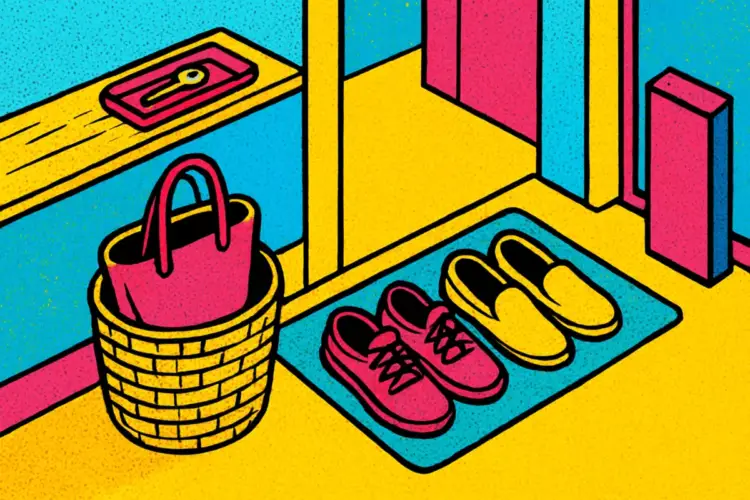
Keys and similar small essentials need an open, visible container close to the door. A shallow bowl, tray, or small basket on a narrow shelf, windowsill, or existing cabinet is enough. The container matters because it draws a clear boundary: keys are not merely “on the counter”; they are in their home.
Choose a tray with a little visual contrast from its surface so it is easy to spot. Keep it reserved for exit essentials. When it fills with receipts, loose change, and batteries, keys disappear and the system loses its point.
2. Contain the bulky item that causes the biggest pile
Usually this is a bag. If drilling is not an option, use a freestanding solution: a slim coat stand with a stable base, a small bench with an open lower shelf, a sturdy floor basket, or the end of a bookcase already near the entry. Pick one primary home, not three possible homes.
A basket is particularly forgiving for soft-sided totes and backpacks. It removes the need to hang a strap neatly, and it keeps the bag from colonizing a chair. A stand is better for a structured work bag or outerwear, provided it cannot tip when loaded.
3. Release processing items into the next step
Mail is different from keys because it requires a decision. Give it a temporary inbox—a vertical file, lidded box, or one upright basket—rather than letting it become a permanent display. The inbox should hold only unsorted paper, not manuals, school projects, or every document you own.
Make the next step visible. Put a small recycling bin or paper bag nearby if that suits the space. Unwanted envelopes and inserts can leave immediately; items needing action go into the inbox. The goal is not to process bills while standing in a coat. It is to stop paper from spreading.
Choose a footprint that protects the walkway
Entry areas feel chaotic quickly because they are circulation space. Before buying or moving anything, measure the narrowest clear route from the door to the next room. Keep that path open when shoes, bags, and a person are all using it.
In a very narrow hall, prioritize vertical or shallow pieces: a slim tray on existing furniture, a narrow floor basket tucked against the wall, and an over-the-door organizer used only if it does not interfere with the door’s movement or the door hardware. In a studio, the landing zone may be just inside the main room rather than directly beside the door. A system placed six steps away but used every day is better than a perfect-looking station that blocks the entry.
If you share a home, assign each person a distinct container or hook position rather than combining all small items in one deep basket. The purpose is retrieval without a morning search.
Make shoes a rotation, not a collection
Shoes are where many entry systems quietly fail. A rack with room for twelve pairs often invites twelve pairs to stay. Instead, make room for the shoes currently in rotation: perhaps the pair worn most days and one weather or activity alternative. The rest belong in the bedroom closet or another designated storage area.
A washable mat, low tray, or open shelf can define the shoe boundary. It also helps protect floors from ordinary dirt and moisture. Let wet footwear dry with airflow rather than sealing it in a closed bin. If shoes are muddy or heavily wet, deal with that mess before placing them with clean indoor items.
Do not force everyone to remove footwear at the door if that is not how your household lives. A landing zone should support a real habit. In that case, a small shoe spot can be reserved for pairs that do come off, such as boots or exercise shoes.
Build it from what you already own before shopping
Try a seven-day prototype using a bowl, a tote, a cardboard box, and a chair or side table that is already in the right place. This reveals what the system needs before you commit to furniture. A tray may turn out to be too small; the bag may need a floor basket; the mail may be better handled near the desk because that is where decisions actually happen.
For example, consider an illustrative one-bedroom apartment where the door opens directly toward the living area. A tenant places a shallow dish on a nearby bookcase for keys, a basket beside it for a backpack, and a narrow paper file on the next shelf for mail. A boot tray sits against the wall, holding two daily pairs. Nothing is attached to the wall, and the whole arrangement occupies an existing corner rather than adding a console table to the walking route.
After a week, adjust according to failures, not appearance. If the backpack still lands on the sofa, the basket may be too far away or too full. If mail never reaches the file, the file may be hidden behind a cabinet door. Move the destination closer, simplify it, or reduce what it is expected to hold.
Use a short reset to keep the landing zone from becoming storage
The entry station works because it is a transition point. It needs a brief reset so temporary items move onward. Pick a natural moment: when taking out recycling, before the weekly grocery trip, or while waiting for coffee to brew on a chosen morning.
- Empty the mail inbox and recycle what has no action attached to it.
- Return stray objects to their real rooms.
- Move off-season shoes out of the rotation.
- Check that keys and access cards are back in the tray.
- Wipe out the shoe tray or shake the mat as needed.
This should take minutes, not become a grand organizing project. If it routinely takes longer, the zone is holding too much or doing work that belongs elsewhere.
Common mistakes that make an entryway harder to use
Buying storage before defining categories
A large cabinet can conceal clutter without solving the arrival sequence. Decide what needs a home first, then select the smallest useful container for each category.
Using a deep “miscellaneous” basket
Deep baskets are excellent for bags and scarves, but poor for keys and documents. Small essential items sink, and every departure starts with rummaging.
Putting the system where it photographs well rather than where you enter
A beautiful bench across the room is not a landing zone if your hands are full at the door. Convenience beats symmetry here.
Letting the station carry emotional clutter
Unopened packages, items to return, and papers that need decisions can create guilt every time you come home. Give such items a scheduled next action elsewhere when possible. The entry should welcome you in, not present a backlog at ankle level.
Your next small move
Tonight, place one empty bowl or tray within easy reach of the door and put your keys in it. Tomorrow, notice the next item that has nowhere to go. Add a home for that one item only. A useful landing zone grows from repeated friction, one solved arrival at a time.







Ad